Dental implants are metal (usually titanium) screws surgically placed into your jawbone under the gums. These screws act as the foundation feet on which your dentist will place dental prostheses.
The working principles and forms of dental implants have changed a lot over the years. However, regardless of how they function, the basic goal is to look and function like natural teeth. That is, they should be aesthetically satisfying as well as allowing you to eat comfortably. In addition, they should be easily cleanable in practice.
Dental implants consist of a screw (placed into the jawbone), an abutment (attached to the implant with a screw), and a crown (attached to the abutment and looks like a natural tooth).
This is the implant itself and is placed inside your jawbone. Since your implant will remain inside your jawbone, you can only see it with dental X-rays. It wouldn't be wrong to simply compare a dental implant to a screw dowel. All intermediate parts that will hold the dental prosthesis are attached to the implant with a screw.
It is the intermediate part that connects your implant and the prosthetic tooth to be made. Like a screw entering a dowel, it is screwed into your implant.
This is your prosthetic tooth. It is not attached directly to your implant. It is attached to the intermediate abutment part.
If you are considering getting a dental implant, let's examine together what path you should follow.
1.
First, your dentist will numb the area where the implant will be placed with local anesthesia. This means that only that area will be numbed. In very rare cases, your dentist may decide to perform the procedure under general anesthesia (complete sedation).
2.
Second, your dentist will prepare your jawbone and surrounding tissues for implant placement.
3.
Your dentist will place your implant in the most suitable area. The most ideal place and the most suitable place may not be the same. This means that your dentist may make various changes, either in advance or during the surgery, by informing you if they can foresee it.
4.
After the anesthesia wears off, it is normal to have some pain in the jawbone and some bleeding in the mouth.
5.
After the implant is placed, the integration process with your jawbone will begin, called 'osseointegration'. The bone will completely surround the implant and become very solid.
6.
Your dentist will recommend a healthy diet of soft and not too hot foods.
7.
If your dentist deems it appropriate, they may give you a temporary prosthesis to use during this process. But remember that this may not always be possible.
8.
After the osseointegration period is completed (probably between 3 and 6 months), your dentist will take measurements to start the dental prosthesis. Then, the dental prosthesis from the laboratory is attached to the abutment placed on the implant.
Remember that the procedure is slightly different for same-day dental implants.
Having good general health and clean oral hygiene is very important for an implant. After that, if you have enough bone to support an implant, you may be a good candidate for a dental implant. Sometimes artificial bone powder called 'bone graft' may be necessary.
If you have a chronic disease or an autoimmune disease, your dentist may request some tests before implant placement.
Also, smoking will greatly affect the success rate of the implant. The negative effects of smoking on wound healing have been clearly demonstrated. You need to have meticulous oral hygiene before, during, and after implant placement.
Most people without chronic or autoimmune diseases who do not smoke excessively or drink alcohol are not at risk for dental implants.
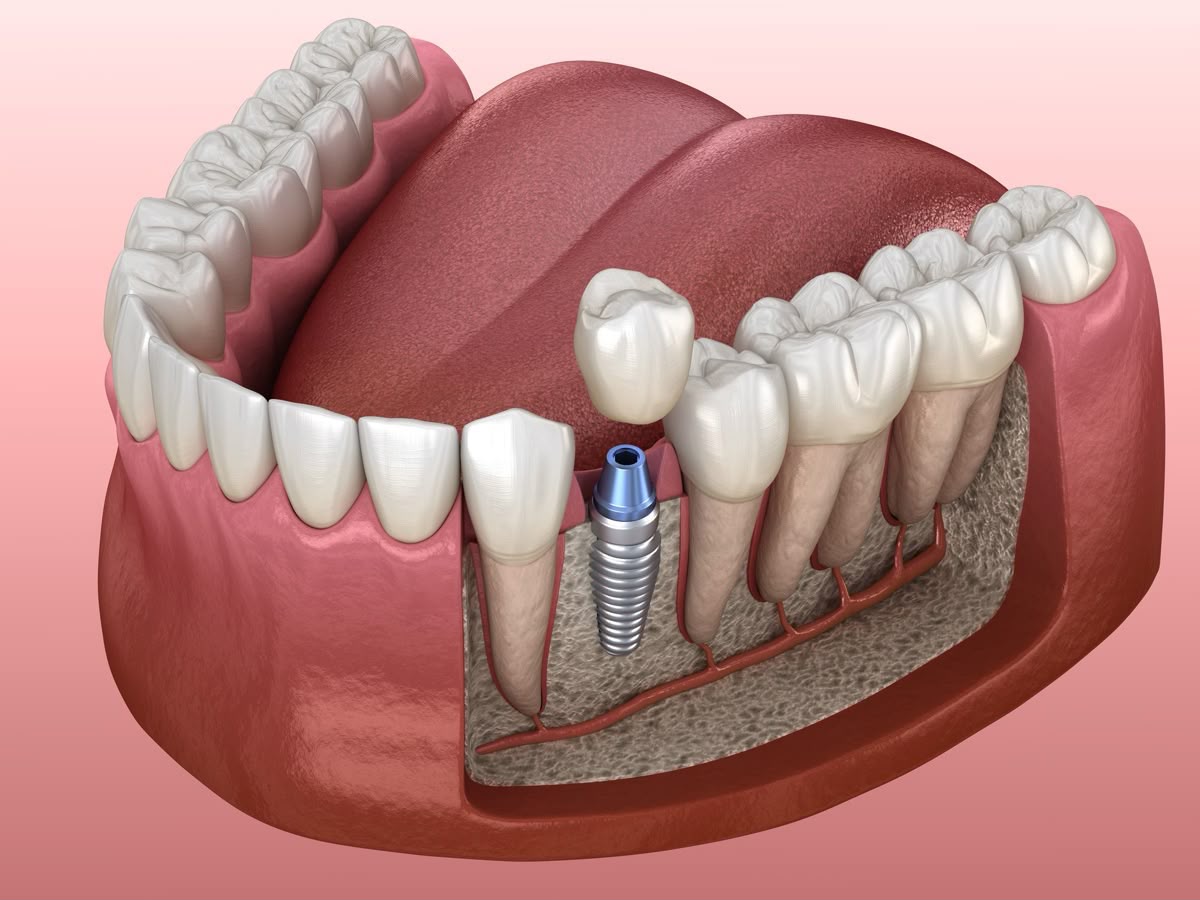
There are two main types of dental implants
1. Standard Dental Implants:
Their sizes start from 8 to 10 mm. A certain bone thickness and height are required.
2. Shorter Dental Implants:
Their sizes start from 4 mm. They are implants developed for areas where there is insufficient bone height. Their manufacturing procedures are slightly different. They can be the most ideal solution for cases where bone graft is not suitable.
A single tooth implant replaces the root of a missing tooth. It allows a prosthetic tooth to be made only in that area. This is not only for aesthetics but also prevents damage to adjacent teeth, prevents natural teeth around from shifting over time, and even helps prevent bone loss. A single tooth implant is an independent unit and does not involve treatment of adjacent teeth, preventing them from being cut and damaged.
Dental implants help support a dental prosthesis when you are missing one or more teeth (even if all your teeth are missing). An implant-supported bridge uses implants instead of receiving support from other surrounding teeth. The type of dental implant your dentist chooses will vary according to your condition. This means that one patient's dental implant cannot be the same as another.
In traditional implant bridges, dental prostheses are cemented to the abutment on the implant. This has two disadvantages.
1.
First; when the prosthesis needs to be replaced or a problem is encountered in the future, the only thing that can be done is for your dentist to remove the prosthesis by hitting it with a mini hammer. There is of course a risk that these hammer blows may damage your implant and even your jawbone.
2.
Second; fixing your dental prosthesis to your implant with cement can lead to odor problems in the future because 'this cement will dissolve over time'. This is the main reason why patients complain that their dental prostheses smell over the years.
Although every surgical operation has pros and cons and dental implants are completely safe, they also have pros and cons.
Unlike traditional prostheses, dental implants fuse and integrate with your jawbone. This allows you to put pressure on your artificial teeth like natural teeth and eat. Dental implant prostheses are generally more comfortable than standard prostheses or bridges. Implant-supported prostheses do not require interfering with surrounding teeth, as in traditional prostheses or bridges. Thus, they allow dental prosthesis to be made without damaging adjacent teeth. Beyond all this, having a dental implant helps preserve your jawbone. When teeth are missing for a long time, the jawbone begins to resorb. This necessitates the need for bone grafts. In more advanced cases, your entire jaw and even your facial structure may become deformed.
The biggest downside of getting an implant is cost. As in almost every country in the world, general health insurance does not cover implants as a 'cosmetic' elective procedure (like zirconium crowns, teeth whitening, etc.) in our country. The most reasonable way to reduce dental treatment costs is to go to your dentist for regular check-ups as much as possible. It should be well known that every postponed dental problem leads to bigger problems and thus much higher costs. A dental problem that can be easily and cheaply solved at the beginning will, if postponed, lead to greater financial burdens as well as a more difficult and longer process. Of course, dental implants are not perfect and flawless. They can fail due to various reasons such as smoking, an autoimmune disease, or uncontrolled diabetes. They can also cause the implant to become loose or painful, in which case they may need to be removed.
Don't hesitate to ask your dentist questions, especially if it concerns your dental health. Below are some basic questions to ask your dentist before surgery.
● What treatment options do you offer to replace a missing tooth?
● How many times have you performed dental implant procedures?
● What is your education and training background in dentistry and dental implants?
● What are the best dental implant options for me? Why?
● Which company manufactures your implants?
● What are the steps in the process?
● What will I experience before, during, and after the procedure?
● Will I experience a lot of pain?
● What is the recovery time?
● How long will I be without teeth?
● What are the risks of the procedure? What are the advantages?
● Can I see before and after photos of other patients you have treated?
Dental implants may seem like a painful procedure because they are screwed into your jawbone. But you will not feel pain because local anesthesia (or general anesthesia depending on the situation) will be applied.
Dental implant prostheses are much safer and more comfortable than traditional prostheses in the long term. They usually do not move and feel like natural teeth.
Dental implants are the most comfortable, safest, and newest way to restore function (eating and drinking), phonation (speech), and aesthetics.
In addition to all these, dental implants are not miracles. You must definitely heed your doctor's warnings and give adequate importance to your oral hygiene.
AESTHETIC DENTISTRY
TEETH WHITENING (DENTAL BLEACHING)
WIRELESS ORTHODONTICS (INVISALIGN)
ORTHODONTICS (BRACES)
ROOT CANAL TREATMENT (ENDODONTICS)
GUM TREATMENTS (PERIODONTOLOGY)
PEDIATRIC DENTISTRY (PEDODONTICS)
IMPLANT TREATMENT
ORAL, DENTAL AND JAW SURGERIES
FRENECTOMY (LIP-TIE / TONGUE-TIE RELEASE)
ALL-ON-4 TREATMENTS
FILLING TREATMENT
FIXED PROSTHETIC APPLICATIONS
Address
Merkez, Lise Cd. 18 C / D, 07980 Kemer/Antalya
Phone
05324401740