Getting a dental implant for the first time can be scary. The idea of getting 4 at once might also make you nervous. Much of this fear probably stems from uncertainty, so let's take a look at the step-by-step process of getting an All-On-4 dental implant.
First; your dentist will want to make you comfortable, so local or general anesthesia will be administered. This is entirely a decision you and your dentist will make together. If your dentist and anesthesiologist find it appropriate, general anesthesia can sometimes be the most comfortable option. But it should be known that a very large proportion of such procedures can be easily handled with local anesthesia.
Second; your dentist will prepare your mouth for implants by removing any remaining unhealthy teeth, diseased or infected tissue from your jaw and gums.
Then; they will begin the implant placement process. This means they will place titanium screws into your jawbone. Most likely, two implants will be placed towards the front of your mouth and two towards the back, so that the 'titanium screws' can evenly bear the force of the denture.
After the implants are placed, your dentist will thoroughly clean the wound areas and suture all incised areas. Then you will be taken to a recovery room where you can rest.
The basic All-On-4 implant procedure includes anesthesia, preparation of the surgical site, implant placement, and post-operative cleaning and suturing.
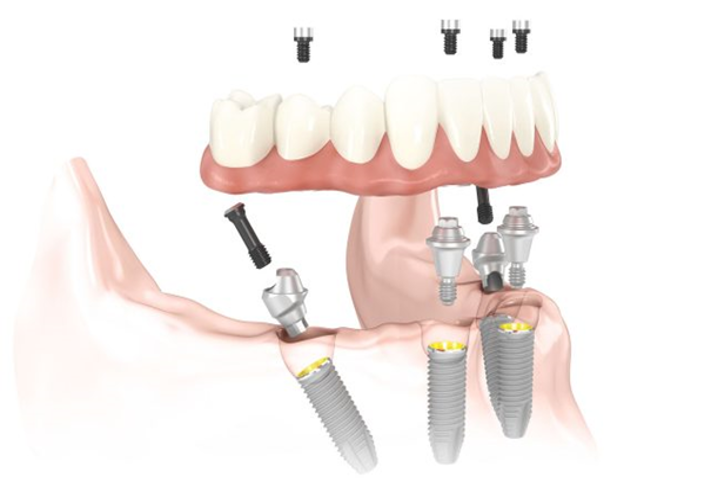
After traditional prostheses are placed, the healing time can vary from 3 to 8 months, but after an All-On-4 prosthesis is placed, permanent porcelains can be placed earlier. The reason is that the implants integrate with your bone and increase prosthesis stability from day one.
During the first hour after your surgery, or until bleeding stops, you need to gently bite on the gauze pads placed over the surgical areas. After the first hour, you may be asked to remove the gauze unless there is excessive bleeding, in which case your dentist will likely replace it with new gauze.
When you return home from surgery, make sure you don't do anything that could harm the surgical areas. Do not rinse or touch the surgical areas except for gentle brushing with a soft toothbrush. Obviously, smoking later (and generally) greatly affects the healing of surgical areas. It is also important to keep your mouth as clean as possible. Your doctor will likely prescribe medication to prevent bacterial infection and promote healing.
Twenty-four hours after surgery, if there is a small amount of bleeding, you can gently rinse your mouth with salt water. Just mix one tablespoon of salt with a glass of water and rinse slowly. You can do this 2-3 times a day.
The best thing you can do in the time following surgery is to rest. Among the things you should not do are bending, lifting heavy objects, or engaging in strenuous activities that could lead to more bleeding and swelling.
Also, it is best to get up slowly and carefully from a lying position. Otherwise, you might feel dizzy. If you are a person who normally exercises, you should avoid it for 3-4 days after surgery.
The most important things to remember during recovery are rest, no smoking or alcohol consumption, pain management, and eating soft foods.
If you notice that bleeding does not stop, this is usually because you are not biting on the gauze pads directly over the surgical areas. Reposition the gauze and check if bleeding has stopped. If this doesn't work and bleeding continues, try sitting upright, avoid physical activity, and apply ice packs to the outside of your mouth. Then biting on a moist black tea bag for about 30 minutes will also help you. If this still doesn't help, be sure to call your dentist to make an appointment.
Swelling is a normal part of having surgery and peaks about 2-3 days after the procedure. Using ice or a cold pack over your cheek within the first 24 hours following the procedure can help keep swelling to a minimum (apply cold for 10 minutes and rest for 10 minutes). Applying cold continuously without a break can cause cold burns (even if you don't feel it initially due to numbness). Also, your dentist may prescribe medication to minimize swelling.
This is an inevitable outcome of this surgery. Your dentist will give you painkillers, and you must take them as directed. It should be remembered that smoking and eating/drinking hot foods certainly increase pain and swelling. If you think you need more medication to control pain, call your dentist.
As long as the foods you eat do not cause discomfort, there is no harm in eating. You should avoid hard foods, candies, or very hot foods, and chewing is not recommended until the numbness in your tongue and lips subsides. Our best advice is to consume only liquid or pureed foods for the first few days after surgery. Most importantly, make sure you are well nourished, no matter how uncomfortable it may be. It is very important for your healing.
You may experience nausea or even vomiting due to accidentally swallowed blood or the medications you will take. If nausea persists or worsens, call your dentist for advice.
About 2-3 days after surgery, you may see discoloration or bruising near the surgical areas. This is a natural result of the surgery and is quite normal. Applying mild heat to your cheek after the first 48 hours following the procedure will help bruising to disperse more quickly.
If you start to feel sharp protrusions like splinters in your mouth, especially in the areas where your teeth were extracted, these may be bone walls of the extracted teeth. After a few days, small bone fragments of extracted teeth may protrude slightly from the gums and cause discomfort. You should not worry about this; you can discuss this with your dentist.
Since your mouth will be open for a long time and your lips will stretch slightly while biting the gauze, it is expected that your lips may be dry or the corners of your lips may be irritated. Small tears or cold sores may occur on the corners of the lips. You can use Vaseline or another moisturizing ointment.
Because your mouth may be open most of the time due to the gauze, this can lead to a sore throat and make swallowing painful. This is a temporary symptom that usually disappears after a few days.
Your jaw muscles may contract from opening your jaw for a long time and holding it in the same position. For this, you can slowly stretch your jaw from time to time, and if your dentist deems it appropriate, they may give muscle relaxants. If you experience any of these symptoms or problems, the first thing you should do is contact your dentist, even if you think everything is fine.
Sometimes you may encounter problems after the healing process. The most common problems you may encounter with All-On-4 implants are:
With any type of surgery, there are always associated risks. Possible complications with the All-On-4 procedure in particular include infection, poor healing, and excessive bleeding. Obviously, your dentist will do everything possible to avoid these risks, but sometimes they happen. After surgery, it is best to watch for these complications and report any abnormal changes to your dentist.
Sometimes dental implants and your bone do not agree. Factors that determine how well an implant will integrate into your bone include smoking, the quality of your bone density, your nutrition, and many other things. If an implant does not integrate with your bone, your dentist may remove the implant, allow the area to heal, and place a new implant.
This is a rare occurrence, but it is still a possibility. Dental implants have an extremely high success rate; however, if they fail, your dentist may either replace the implant immediately with a new one or allow the area to heal and re-implant after a few months. The most common cause of failed implants is gum problems, which you can prevent by taking good care of your gums and going for regular check-ups.
AESTHETIC DENTISTRY
TEETH WHITENING (DENTAL BLEACHING)
WIRELESS ORTHODONTICS (INVISALIGN)
ORTHODONTICS (BRACES)
ROOT CANAL TREATMENT (ENDODONTICS)
GUM TREATMENTS (PERIODONTOLOGY)
PEDIATRIC DENTISTRY (PEDODONTICS)
IMPLANT TREATMENT
ORAL, DENTAL AND JAW SURGERIES
FRENECTOMY (LIP-TIE / TONGUE-TIE RELEASE)
ALL-ON-4 TREATMENTS
FILLING TREATMENT
FIXED PROSTHETIC APPLICATIONS
Address
Merkez, Lise Cd. 18 C / D, 07980 Kemer/Antalya
Phone
05324401740